
SCIA and starting works: when you can really begin
SCIA and starting works: when you can begin, which filings you need and who answers if the filing doesn't hold up. A guide for Milan and Lombardy.

In Milan, with a SCIA under art. 22 (certified notice of start of activity) works can begin on the very day the online filing is made, provided no consents are missing. With a SCIA under art. 23 the site has to wait 30 days from filing, or until the required approvals have been issued and the time limit has run.
The most common advice is that you just file and go. That is half true, and the missing half is the expensive one. The date that matters is not the protocol date: it is the day the file is complete, the receipt is in your hands and the prerequisite authorisations have already been obtained.
If you are buying, renovating or financing a property in Milan or the surrounding towns, you need to keep two dates apart: filing and the actual start. Between them there can be a few hours or a good month, and the difference is decided by how the works are classified, not by the hurry of someone who has already ordered the materials.
Contents
- When a SCIA lets you start works
- What a SCIA is and how it differs from a CILA
- What to complete before filing and before signing with the contractor
- Who is responsible for what: owner, technician and contractor
- A two-room flat to renovate between Milan and Bresso
- Mistakes to avoid in a SCIA filing
- Frequently asked questions about SCIA and starting works
When a SCIA lets you start works
In Milan the notice has immediate effect: works can start on the same day as the online filing, as stated on the Comune di Milano SCIA art. 22 service page. The filing can only be made online, through the Impresainungiorno platform, and there is no alternative route at the counter.
Immediate effect is not an unconditional authorisation. If the works require consents linked to landscape, hydrogeological, environmental or historic-artistic constraints, the site does not open until those consents have been obtained. Keep the file in three distinct parts: the correct building permit type, the technician’s sworn statement of compliance, and the prerequisite authorisations.
| Permit | When you can start | Condition to check |
|---|---|---|
| SCIA art. 22 without consents | From the day of the online filing | Complete filing and protocol receipt |
| SCIA art. 22 with consents | Once the consents have been obtained | Landscape, hydrogeological, environmental or historic-artistic constraints |
| SCIA art. 23, alternative to the permesso di costruire (building permit) | 30 days after filing, or after the consents and once the time limit has run | More substantial alterations, to be classified with the technician |
The SCIA used as an alternative to the building permit follows a slower regime, and the Comune di Milano makes clear that works cannot begin before filing. The waiting period exists because the works have a greater planning impact, not because the office is slow.
The date to put in the cronoprogramma (works schedule) is therefore the latest of three: complete filing, protocol receipt, consents in hand. A plain example. Moving two internal partition walls in a flat with no constraints is a job that can start straight away. Altering a façade on a listed building is a different filing altogether, and the technician has to classify it before anyone signs the order with the contractor.
What a SCIA is and how it differs from a CILA
The SCIA, Segnalazione certificata di inizio attività (certified notice of start of activity), is a building permit type provided for by article 22 of DPR 380/2001, the Testo unico dell’edilizia (Consolidated Building Code). Its general framework comes from Law 122/2010, which in many administrative procedures replaced the old Denuncia di inizio attività (declaration of start of activity), as set out in the Istat page on building permits.
It is not an application waiting for a permit. It is a notice backed by an asseverazione (sworn technical statement): the technician declares that the works comply with planning, building, seismic, health and hygiene, safety and energy-efficiency rules. The Comune keeps its powers of inspection and can issue orders to stop or require changes.
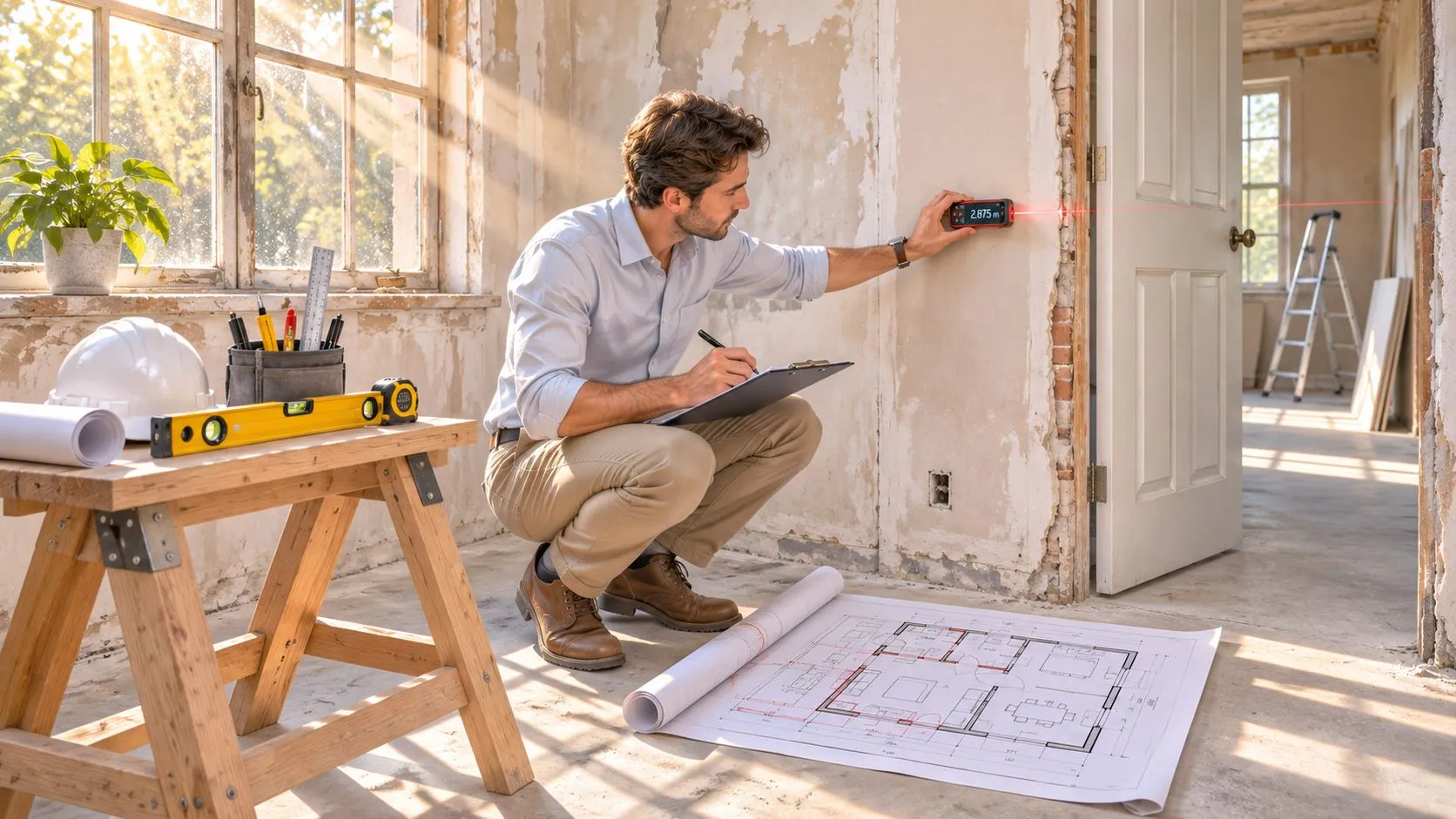
The CILA, Comunicazione di inizio lavori asseverata (sworn notice of start of works), covers lighter work, usually internal and non-structural: systems, new bathrooms, openings in non-load-bearing walls, floors. Here too the sworn statement is the signature by which the technician takes responsibility for compliance, and the three-year deadline for completing the works runs from the protocol date of the original CILA.
If works start before filing, the Comune di Milano accepts a late CILA with a penalty of €333 under article 6-bis, paragraph 5, of DPR 380/2001 (Comune di Milano CILA service). That payment does not regularise works that needed a SCIA: it settles a delay, not the wrong permit.
The most expensive vocabulary mistake in this field is calling every filing a start of works.
What to complete before filing and before signing with the contractor
The sequence has to be closed before you sign with the contractor, not after. Each step has a reason and a point where it usually breaks.
- Measured survey checked against the planimetria catastale (cadastral floor plan) and previous permits. It tells you what actually exists. The breaking point is an as-built state that differs from the floor plan: if this fails, everything else fails with it.
- Permitted use and planning compliance, checked against the PGT (Piano di Governo del Territorio, the town plan) and the Comune’s building regulations. This is where an undeclared change of use comes out, one that often exists only in the deeds.
- Constraints and prerequisite authorisations: landscape, hydrogeological, environmental, historic-artistic. The breaking point is finding them after filing, when the site is already open.
- Classification of the works as SCIA art. 22, SCIA art. 23 or CILA, based on their real planning impact, not on the name the works have in the specification. If the property needs a deep renovation, the logic of the checks stays the same (renovating a flat in Milan).
- Drawings and sworn statement by a qualified technician, with a computo metrico (bill of quantities) consistent with the works described. The breaking point is a bill of quantities that does not match the project: works priced in the bill but missing from the drawings.
- Filing on the Comune’s online portal, with fees, penalties and charges paid through PagoPA (Italy’s public payments platform), as stated by the Comune di Milano on the Sportello unico (one-stop building desk) online channel.
- Keeping the receipt and consents before ordering materials or opening the site. The document that counts is the receipt, not the intention to file.
The two dates to keep separate
The works schedule needs two separate lines: the date of complete filing and the date of the actual start. The Comune gives as the valid date that of the complete filing of the SCIA, together with the receipt and any consents. The protocol number alone is not a start date.
A site starts when the file is complete, not when the protocol number arrives.

Who is responsible for what: owner, technician and contractor
| Party | What they declare or check | Most frequent weak point |
|---|---|---|
| Owner | Title to the property, consent to the works, payment of fees and charges | Starting the site without a complete filing |
| Certifying technician | Compliance of the as-built state, rules and constraints, drawings | Sworn statement not consistent with the works |
| Works supervisor | Consistency between site and project until completion | Discrepancies not reported while works are under way |
| Contractor | Execution in line with the drawings and safety rules | Works carried out before the permit |
What popular guides skip is that the SCIA declares compliance; it does not make it final. For a building SCIA, administrative checks can continue within 30 days and, if shortcomings emerge, the Comune can prohibit the works from continuing or require them to be brought into line, as the Impresainungiorno Lombardia guide to the SCIA points out. The real risk is starting fast with an incomplete file: a halted site, reinstatement, a delayed sale, a property that is harder to finance.
Working rule: a week of waiting before filing costs less than a day of stoppage afterwards.
At Quantum Re we follow every deal from start to handover, with a team of professionals, and the building filing is one of the items we check before committing capital. The three questions to ask the technician before signing are simple: which permit type have you chosen and why, which consents are missing, and who is responsible if a discrepancy emerges after filing. For legal and tax matters, the answer lies with a notary, a lawyer or an accountant.
A two-room flat to renovate between Milan and Bresso
Take a hypothetical case. A 1960s two-room flat in the Isola district, 55 sq m, with internal partitions to move and systems to redo. The first step is the survey against the cadastral floor plan, the second the building regulations, the third checking the constraints on the building. If the works stay internal and non-structural, the classification points to a CILA. If structures or façades are involved, the technician considers a SCIA and checks what applies to the property.
The same job, in Bresso or Monza, may be documented differently. On 27 March 2025 the Conferenza Unificata (the joint State-Regions-local authorities conference) amended the national forms for the SCIA, CILA, building permit and alternative SCIA, and the Regions were able to adapt the variable sections to their own rules by 9 May 2025, as set out in the Italia Semplice survey of building regimes. Since then the national form is only the starting point.
A warning worth money: a SCIA filed in Milan does not prove the compliance of a property in Bresso, nor its marketability. Four things change, and none of them is obvious:
- Forms, with regional sections and attachments that can differ even between neighbouring towns.
- Building regulations, which decide on heights, floor areas, distances and permitted uses.
- Online procedures, with portals and payments that differ from one town to the next.
- Local constraints, from landscape to redevelopment zones.
Mistakes to avoid in a SCIA filing
The costliest mistake is starting before the permit and counting on a sanatoria (retrospective regularisation). For works already started without a SCIA under art. 22, the Comune di Milano allows regularisation only if the works comply with planning and building rules both at the time they were carried out and at the time of the application, and filing voluntarily while works are in progress does not cancel the €516 penalty, citing article 37, paragraph 5, of DPR 380/2001. For a retrospective SCIA under article 37, paragraph 4, the penalty can range between €516 and €5,164 (SCIA in sanatoria, Comune di Milano).
The other four, in order of frequency:
- Confusing art. 22 and art. 23 and opening the site before the waiting period is over. Warning sign: nobody has put in writing which article applies.
- Reading the protocol number as a final go-ahead while consents are still missing. Sign: the authorisation is not in the folder, but the contractor already has the keys.
- Using a SCIA from another Comune as proof of compliance. Sign: the filed floor plan refers to a different address.
- Calling everything a CILA or everything a SCIA without checking the permit type. Sign: structural works described as maintenance.
The check has to be made on the file before the start, not after the first site visit.
Frequently asked questions about SCIA and starting works
Can I start on the same day I file? With a SCIA under art. 22, yes, if no consents are needed. The date that counts is when you have the complete file and the protocol receipt in hand; with constraints, the authorisations too. And even with everything in order, the authorities keep 30 days to check and step in: if you open the site on the same day, you are working inside that risk window.
Are SCIA and CILA interchangeable? No. The scope of the works decides the permit type. A late CILA, with its penalty, does not cover works that required a SCIA.
What happens if I have already started the works? The permit still has to be filed and the penalty is still due. Before filing the application, have the technician check whether the works can be regularised and which article applies.
Do I need a notary? For the deed of sale or transfer of the property, yes. For the building permit, the point of reference is the qualified technician; for legal and tax matters, a lawyer or an accountant.
What changes between Milan and other towns in Lombardy? Forms, building regulations, online procedures and local constraints. National law sets the framework; the answer comes from the one-stop desk of the Comune where the property is located.
If you are considering a purchase or an auction and want someone to read the building file before you decide, you can request a QRE Analysis of the property.
Sources: Comune di Milano, SCIA art. 22, SCIA art. 23, SCIA in sanatoria and CILA services; Istat, SIQual, building permits; Italia Semplice, Ricognizione degli interventi edilizi e dei relativi regimi amministrativi, 2025; Impresainungiorno Lombardia, Che cos’è la SCIA.